
West Africa Business Opportunities: ECOWAS, Two Currencies, One Corridor
Talk to us about this service
Trade, import, logistics, sourcing — whatever you're planning, the fastest way to a quote is a WhatsApp message. Our team replies during Lagos business hours.
WhatsApp usYour message tells us which page you came from
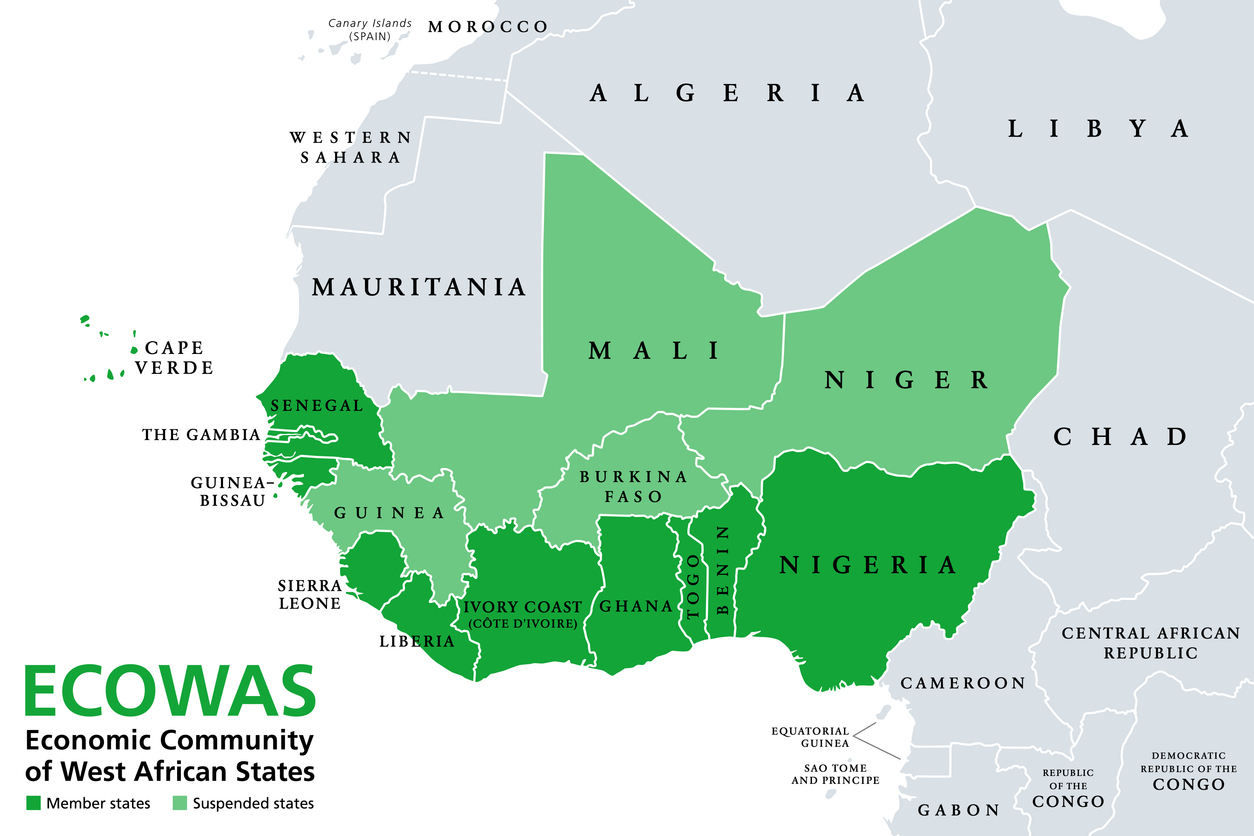
West Africa is sometimes treated as a single regional market because ECOWAS exists and a common external tariff applies. In commercial reality there are two quite different regions inside it, separated by currency, and the difference matters more to a business than anything in the trade protocol. Which side of that line your customer sits on will shape your pricing, your payment terms and your appetite long before tariffs do.
Two currency zones, two businesses
| The naira and cedi markets | The CFA franc zone | |
|---|---|---|
| Countries | Nigeria, Ghana, Guinea, Sierra Leone, Liberia, The Gambia | Côte d’Ivoire, Senegal, Mali, Burkina Faso, Benin, Togo, Niger, Guinea-Bissau |
| Currency | Independent, floating, historically volatile | The West African CFA franc, pegged to the euro |
| Getting paid in hard currency | The central commercial problem — availability as much as rate | Materially easier, which is the zone’s single biggest advantage |
| Market size | Much larger, dominated by Nigeria | Smaller individually; meaningful in aggregate |
| Business law | Common law, country by country | Harmonised under OHADA, which makes multi-country operation simpler |
| Who it suits | Businesses chasing volume and willing to manage currency risk | Businesses that value predictability over scale |
The practical implication: a company nervous about FX should look at Abidjan and Dakar before Lagos, even though Lagos is the bigger prize. A company that can price for currency movement and wants volume should accept that Nigeria is where the volume is and build the FX management to match.
What ECOWAS actually gives you
- A common external tariff. Goods entering the region from outside face a harmonised band structure, with additional levies applied nationally. This makes duty planning across the region more predictable than it used to be.
- A trade liberalisation scheme for goods originating in the region, which can move between member states free of duty — provided the product is registered under the scheme and the rules of origin are satisfied and certified. That registration step is where most of the benefit is lost, because it is administrative and unglamorous and businesses skip it.
- Free movement of persons for citizens of member states, which matters for staffing more than most plans assume.
- What it does not give you: a single market in practice. Standards, product registration, excise and enforcement remain national, and borders still take time.
The corridor
The coastal belt from Lagos through Cotonou, Lomé and Accra to Abidjan is the densest stretch of economic activity in the region, and the road that links it is the single most important piece of trade infrastructure in West Africa. It is also where the friction is most visible: the journey takes far longer than its distance warrants, and most of the excess is spent at borders rather than on the road.
Three consequences for anyone trading regionally:
- Documentation determines transit time, not distance. A properly prepared transit declaration with the right certificates crosses; an incomplete one waits.
- The ports compete, and you may use that. Tema, Lomé, Cotonou, Abidjan and Lagos serve overlapping hinterlands. For inland destinations, the cheapest port is often not the nearest one once dwell time and haulage are counted.
- The landlocked states — Mali, Burkina Faso, Niger — are served through coastal ports under transit arrangements. That transit business is a substantial and under-served logistics market in its own right, with real complexity around bonds and escorts.
Sector demand across the region
- Construction materials. Urbanisation is fast and construction is continuous. Cement capacity is largely regional; finishes, fittings, electricals and glazing are mostly imported.
- Power and solar. Grid reliability varies from poor to adequate, and commercial users buy their own generation. Equipment demand is steady and the customer pays commercially.
- Food processing and packaging. The region grows and imports food and imports nearly all of its packaging. Packaging in particular is poor value density and therefore structurally suited to local production.
- Agricultural commodities outbound. Cocoa from Côte d’Ivoire and Ghana, cashew from Côte d’Ivoire, Benin and Nigeria, sesame, shea, gum arabic and ginger from the Sahelian belt. The processing gap is wide and governments are pushing on it.
- FMCG distribution. Large, fragmented, relationship-driven, and the hardest thing for a foreign brand to build from scratch.
- Logistics and storage. Thin outside the capitals, and the gap widens the further inland you go.
The practical obstacles, stated plainly
- Foreign exchange in the non-CFA markets — availability, not only rate. Build pricing that can move and payment terms that do not leave you long local currency.
- Power cost as a line item in anything manufactured.
- Port and border time, which is a working-capital cost whether or not it appears in a budget.
- Counterparty verification. Advance-fee and impersonation fraud is a real and persistent feature of regional trade in both directions. Verify before you ship and before you pay.
- Security in parts of the Sahel, which is a genuine constraint on where goods can safely move and should be assessed route by route rather than country by country.
Honest assessment
West Africa rewards businesses that are physically present in the chain — holding stock, clearing their own goods, knowing their customers — and punishes those that try to serve it at arm’s length from abroad. The margin that looks attractive on paper is consumed by port time, currency movement and bad debt unless somebody local is managing all three.
For a first entry, the sensible shape is one market, one partner, stock held locally, and a second market only once the first is paying. Attempting the whole region at once is the most common way to be busy everywhere and profitable nowhere.
What Wigmore Trading does
We are a Nigerian-registered trading and logistics company with a regional reach, and we are the local side of the chain for businesses selling into or buying out of West Africa.
- Import, clearing and distribution into Nigeria, with local invoicing so your customers buy from a local counterparty
- Warehousing in Lagos, including bonded storage — see our warehouse space guide
- Regional freight and transit along the coastal corridor and into the landlocked markets, with the documentation handled
- Sourcing and export of regional commodities — cocoa, cashew, sesame, shea, gum arabic, ginger — graded and documented to buyer specification
- Counterparty checks before you ship or pay, in either direction
The trade tools include landed cost, duty and HS code lookups built around the regional tariff.
Next step: tell us the product and the markets. We will tell you which port to use, what it lands at, and where the friction will be. Contact the desk.
Related reading
- Nigeria Business Opportunities: 230 Million People and a Hard Operating Environment — the sectors with real demand and the constraints that bite
- Ghana Business Opportunities: Smaller Market, Easier Entry — entry rules, Tema port and cedi exposure
- Africa Business Opportunities: A Continent of Fifty-Four Markets — reading the continent market by market
Tariffs, trade scheme registration, transit arrangements and security conditions change continuously and differ by country. This article is indicative as at 2026; verify current requirements and route conditions before shipping.

Comments are closed.